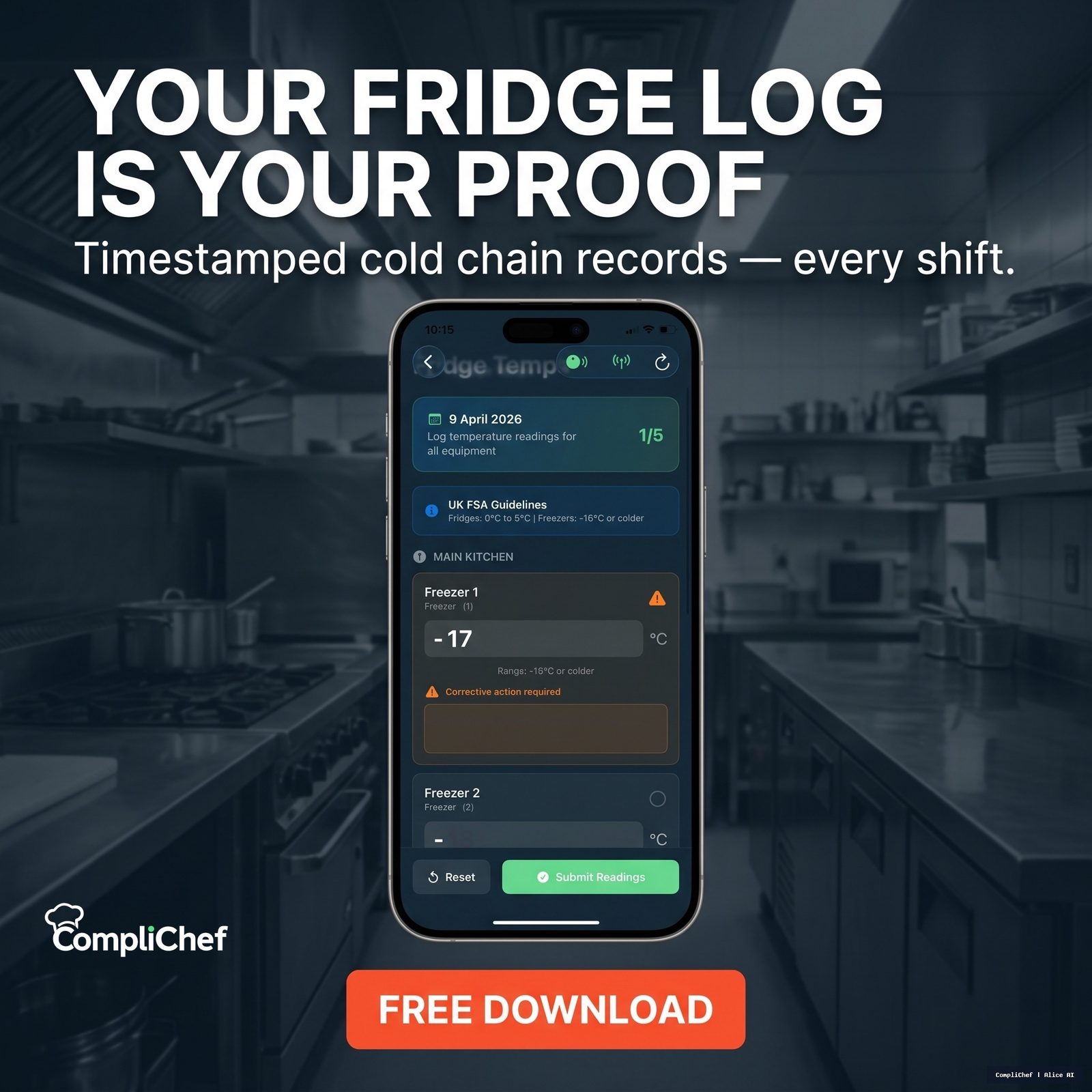
Why Temperature Monitoring Is Non-Negotiable in UK Hospitality
Temperature control sits at the very heart of UK food safety law. Under the Food Safety and Hygiene (England) Regulations 2013 and its devolved equivalents, food businesses are legally required to keep food out of the temperature danger zone (8°C–63°C) and to maintain verifiable records proving they do so consistently. Fail on either count and you are not just risking a poor hygiene rating — you are risking a prosecution, a closure notice, and the very real harm that comes from a preventable foodborne illness outbreak.
Yet, across the hospitality industry, temperature monitoring remains one of the most poorly executed compliance tasks. Here is why — and how to fix it.
The Very Real Risks of Manual Temperature Logs
Paper-based and manually entered temperature logs have been the industry default for decades. They are also one of the biggest sources of compliance risk a food business faces. Here is what goes wrong:
Inaccuracy and Human Error
- Staff record temperatures without actually taking a reading — a habit known informally as pencil whipping
- Readings are taken at the wrong time or from the wrong location within a fridge or food batch
- Illegible handwriting, incorrect units (°F vs °C), or simple arithmetic errors corrupt the record
Gaps in the Record
- Manual logs rely entirely on staff remembering to check at the right intervals during a busy service
- Overnight, weekends, and bank holidays create dangerous monitoring gaps — precisely when equipment failures go unnoticed the longest
- Staff absences mean checklists simply do not get completed
No Real-Time Alerts
- If a fridge door is left ajar at midnight, a paper log tells you nothing until the morning walk-in check — potentially hours of spoilage and safety risk later
- There is no mechanism for a manual system to alert anyone, at any time, to an out-of-range reading
Audit and Legal Vulnerability
- Paper records are easily lost, damaged, or destroyed — deliberately or otherwise
- Reconstructed or backdated logs are detectable by a trained EHO and can escalate a routine inspection into a formal investigation
Corrective Actions: What They Are and Why They Matter
A corrective action is the documented response taken when a critical control point (CCP) falls outside its safe limit. In temperature monitoring, this typically means:
- Hot food below 63°C: Reheat rapidly to above 75°C (82°C in Scotland), or discard if it has been in the danger zone for more than two hours
- Cold storage above 8°C: Assess time in danger zone, quarantine affected stock, investigate and resolve root cause, record action taken
- Delivery temperatures out of range: Reject the delivery, record rejection, notify your supplier
The critical point most operators miss is that the corrective action must be recorded. A reading that shows a problem with no documented response is evidence of a failure — not a near-miss successfully managed. EHOs look for both the out-of-range reading and the corresponding corrective action. One without the other raises serious concerns.
What EHOs Actually Look for During Temperature Inspections
Enviromental Health Officers (EHOs) are experienced, methodical, and fully aware of every shortcut hospitality businesses tend to take. When reviewing temperature records, they are specifically looking for:
- Consistency — Do readings occur at the correct, regular intervals across all days of the week, including weekends?
- Plausibility — Are fridge temperatures suspiciously identical across every single entry, suggesting fabrication?
- Corrective actions — When an out-of-range reading appears, is there a corresponding documented response?
- Calibration records — Has the thermometer being used been calibrated and is there evidence of this?
- Traceability — Can the record be linked to a specific member of staff and a specific piece of equipment?
- Completeness — Are there unexplained gaps, missing dates, or incomplete entries?
A well-maintained, timestamped, automatically generated digital log addresses every single one of these concerns at a stroke.
How CompliChef's Integrated Bluetooth Probes Transform Temperature Compliance
CompliChef has built its temperature monitoring tools around one principle: compliance should happen automatically, as a by-product of normal kitchen activity, not as an extra administrative burden on your team.
The Integrated Bluetooth Cooking Probe
The CompliChef Bluetooth cooking probe is designed for zero-friction use during food preparation and service:
- Switch on the probe — it automatically connects to the CompliChef app via Bluetooth, with no manual pairing required after initial setup
- Insert the probe into the food — the temperature reading appears instantly on the device screen
- The reading is automatically logged in the app, timestamped and assigned to the relevant food item, batch, or task
There is nothing extra to type, no paper to fill in, no spreadsheet to update. The act of taking the temperature is the record. Staff spend the same amount of time they always did checking food temperatures — but now that check generates a complete, auditable, legally defensible log automatically.
The Fridge and Freezer Bluetooth Thermometer
For continuous cold storage monitoring, CompliChef's wireless fridge and freezer thermometers provide 24/7 automated logging:
- Compatible with both iOS and Android, the sensor pairs seamlessly with the CompliChef app on any device your team uses
- Readings are automatically logged at set intervals throughout the day and night — no staff action required
- If temperatures drift outside your set safe range, the app delivers an instant alert, allowing you to act before stock is compromised
- Every reading is stored securely in the cloud, accessible at any time for audit, EHO inspection, or your own quality review
This means your cold storage compliance is continuous, not spot-checked — which is exactly what the regulations require and what EHOs expect to see.
Making the Switch: What to Expect
Moving from paper logs to CompliChef's automated temperature monitoring is straightforward:
- Setup is fast — probes and sensors pair to the app quickly, and your team can be up and running within a single shift
- Training is minimal — if staff can use a smartphone, they can use CompliChef
- Records are immediate — from the first reading, your digital audit trail begins building automatically
- EHO-ready reports — logs can be exported or reviewed directly from the app during an inspection visit, presenting your compliance record clearly and professionally
The Bottom Line
Temperature monitoring is not a box-ticking exercise — it is your primary defence against foodborne illness, regulatory action, and reputational damage. Manual logs introduce risk at every step. CompliChef's Bluetooth probe and fridge-freezer thermometer remove that risk by making accurate, automatic, timestamped temperature recording simply part of how your kitchen operates.
If an EHO walked in tomorrow, would your temperature records tell the right story? With CompliChef, the answer is always yes.